
Layer by layer, or a single band: each voice must exist
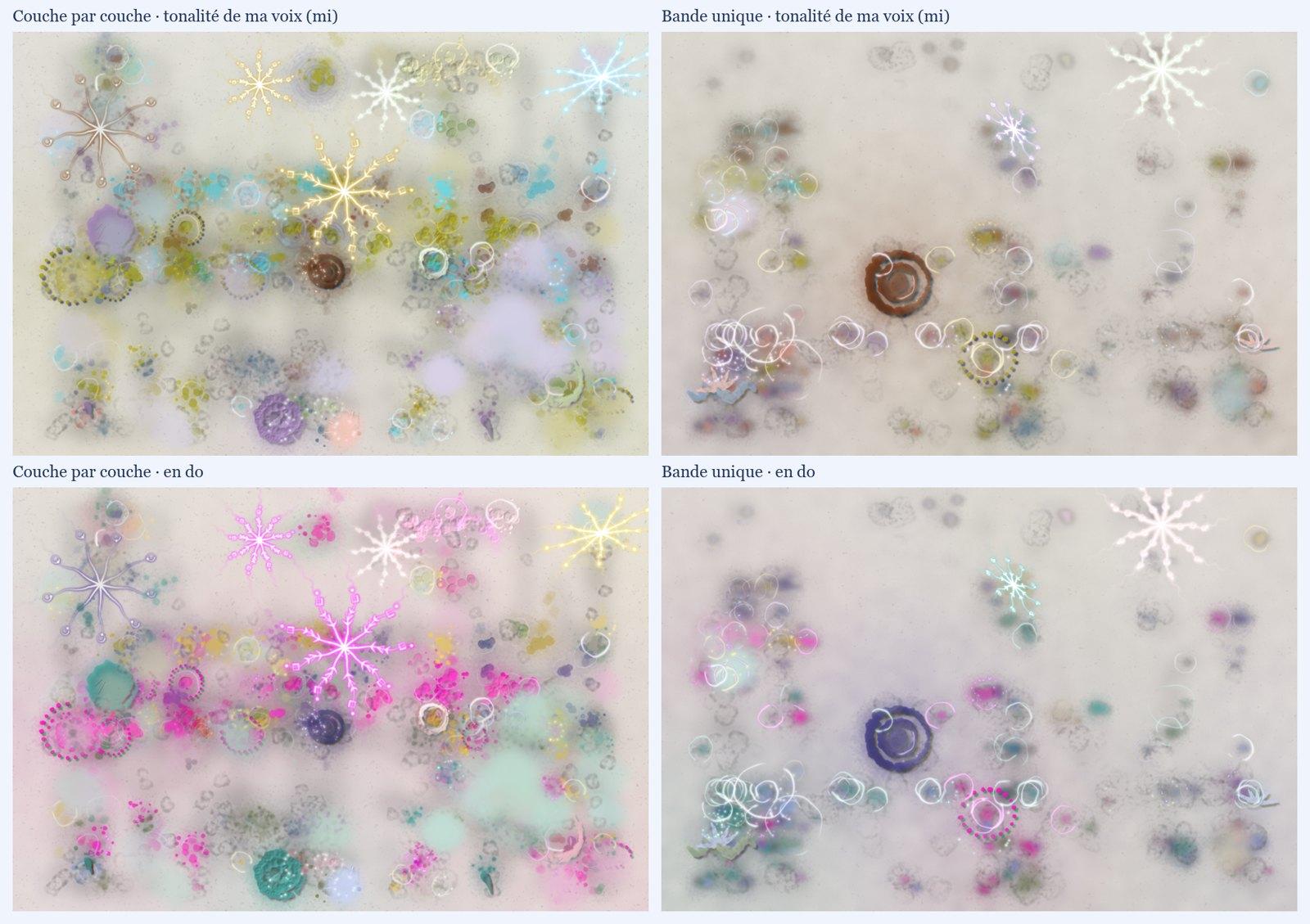
My three voices each paint their own layer; what if I were to blend them into a single band before painting? The paint then dissolves into a pale veil: when the voices merge, the time, space and gesture of each fade away.
What I did
My works without data consist of three voices, and each paints its own layer: the canvas retains three timelines and three gestures, which are superimposed upon one another. I wanted to explore the alternative approach: to bring the three voices together into a single sound band, then have the tool paint it. I did this first with the three Concone lessons from prototype 22 (‘a’, ‘o’, ‘i’), then with the ‘Étude a’.
What I observed
In the single band, the tool can now only ‘hear’ 47 per cent voice (82 to 85 per cent for each voice individually); the rest becomes breath noise (52 per cent), and silence almost disappears (1 per cent). Pitch is lost: when faced with three simultaneous notes, the tool hears low notes that do not exist. The vowel heard becomes mainly ‘é’ (39 per cent), a vowel that none of the three voices was singing.
The painting dissolves into a pale veil.
What I make of it
When the voices merge, the time, space and action of each fade away: they no longer engage in dialogue; they blend together. Layer by layer, each voice exists; the single band is their fusion, and it has the beauty of a veil, like mist over water. My works retain the layers. The veil could become a fourth layer: the fusion laid over the three voices.
Questions
Light and shadow: can a single work reveal itself in both ways, layer by layer and as a veil?
What does the ear retain when the eye can no longer distinguish the voices?
References
Giuseppe Concone, 50 Lessons in Singing, Op. 9 (edition for high voice, Schirmer, IMSLP, public domain).