
Autotune: what it might cost my voice, its painting and its sculpture
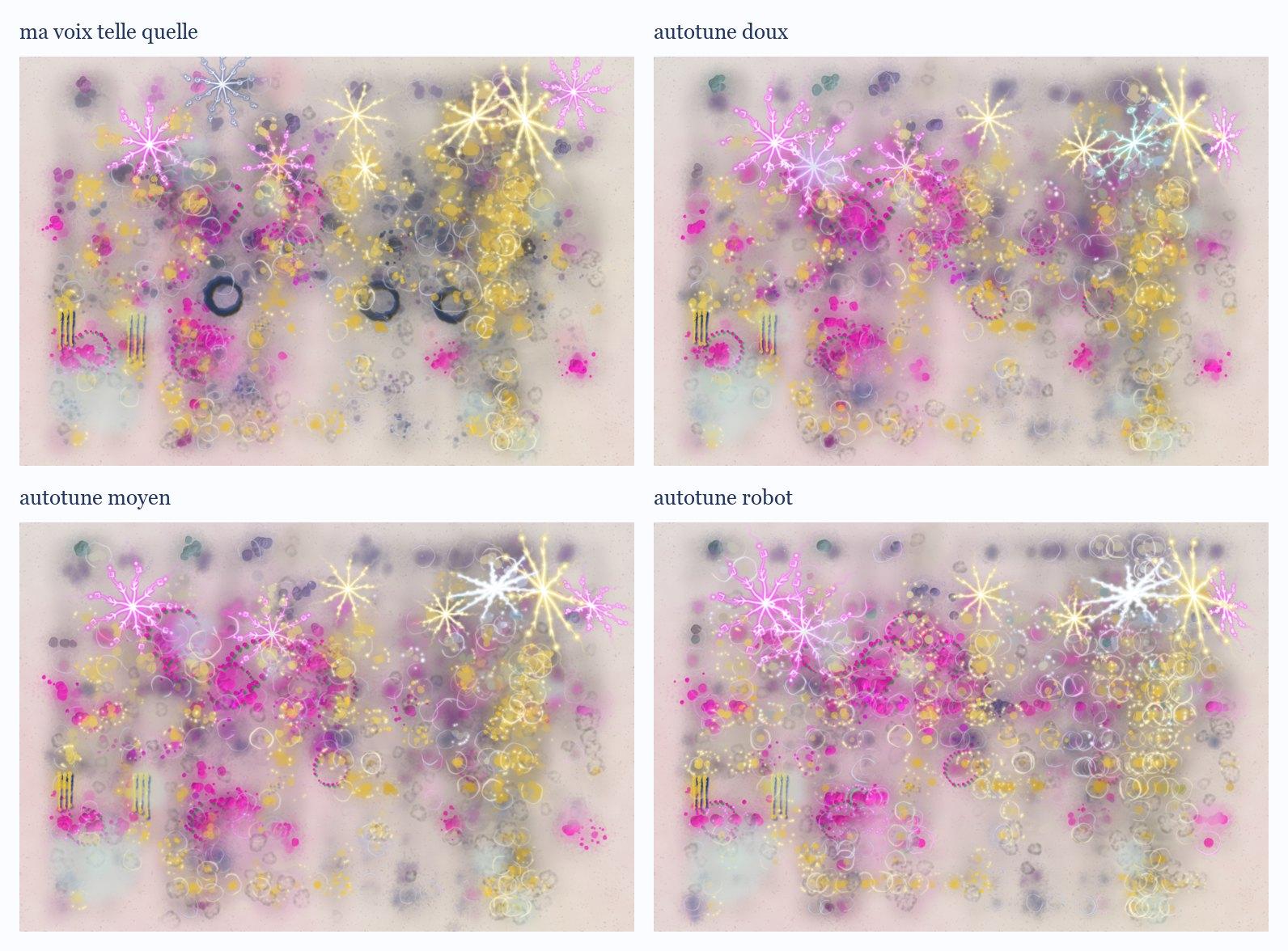
I processed three of Concone’s lessons using Autotune, in ‘soft’, ‘medium’ and then ‘robot’ modes, and let the tool paint them. As the pitch is corrected, the vibrato disappears, the vowel shifts, and the canvas loses its ripples.
What I did
Autotune corrects pitch by bringing each note back to the nearest note in the scale, more or less quickly. I applied it at three different intensities to my Concone lessons (‘a’, ‘o’, ‘i’), then had each version painted, layer by layer, alongside my unprocessed voice.
What I observed
Autotune in ‘robot’ mode removes the vibrato (from 21 per cent to 3 per cent of the voice), and with it the ripples in the water, which represent the shape of my vibrato in the painting. The gentler settings alter the vowel heard about one in every four times: by shifting the pitch, the device also shifts the timbre of the voice.
What I make of it
When you listen to it, ‘robot’ mode is neither human nor robotic: it is instrumental, plastic. The beauty of a lyrical voice lies in the roundness of the vowels, in agility, in the control of breath through vibrato, in resonance and in the interplay of soft, loud, breathy and dramatic elements: this is precisely what Auto-Tune takes away. Using it would produce a pitch-perfect sound, but no longer a human voice—one that is sung and felt. Based on this test, Auto-Tune comes at too high a cost, both to the voice and to painting: it remains a unit that I measure, rather than a stage in my creative process.
Questions
Is what a device corrects still my voice that paints?
References
Auto-Tune (Antares Audio Technologies, Andy Hildebrand, 1997). Giuseppe Concone, 50 Lessons in Singing, Op. 9 (Schirmer, IMSLP, public domain).