
In D or C: it’s not about the key, it’s about the fusion
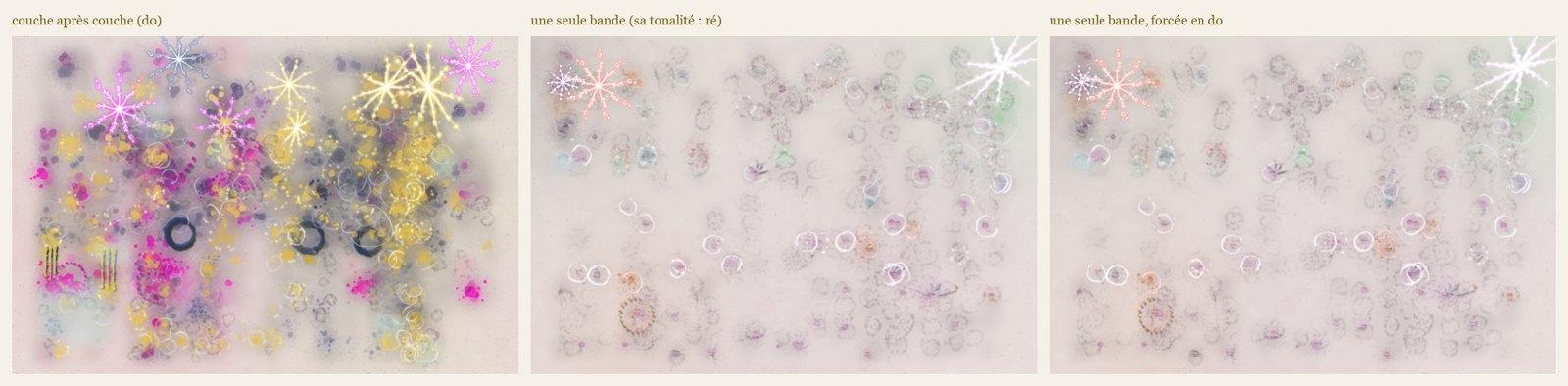
The single-band painting had taken on a different key to that of the three-layer version (D rather than C). To find out whether it was the key that made it look so pale, I repainted it in C: it remains almost identical.
What I did
The key of each painting comes from my voice, not from an arbitrary choice: the note I sing most often shifts the colour wheel by 30° per semitone; C retains my original colour palettes. The three layers of Concone are in C; whilst the single band was painted in D. I therefore forced the band into C, to compare it at the same colour.
What I observed
When voices blend, the note heard most often changes: the band shifts the key. However, when forced into C, the band remains a veil: the same pallor, the same faded marks.
What I make of it
What erases the paint is the blending of the voices, not the colour. The key merely shifts the hues; the substance, however, comes from what the tool hears in each voice. I changed only one variable, and it was not enough to explain the paleness: that is the very principle of a test.
Questions
Is the key derived from the voice the same as that which the ear hears?
References
My rule of transduction: the key derived from the voice (16 October 2026), the twelve-position colour wheel.