
The squillo: the ring of my voice, painted
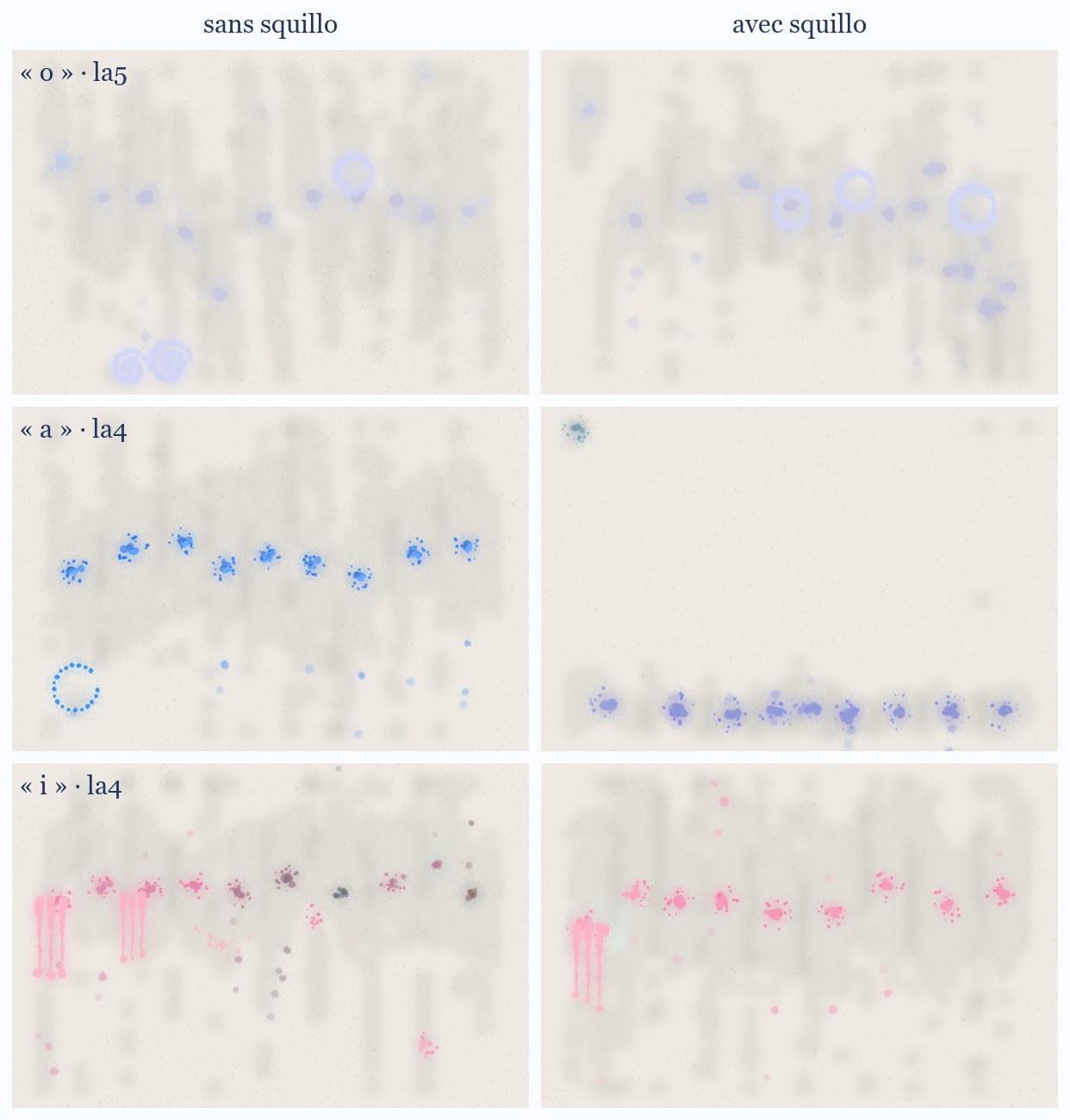
The same note, the same vowel, sung first in a straight tone, then with the ‘squillo’ – that ringing quality that carries the voice in opera. I wanted to know what the tool hears, and what the painting captures: a thread of light for ‘a’, ‘o’ and ‘ou’, flashes for ‘i’.
What I did
I sang each vowel on a single note per take, for one minute: at A4, then at A5, without the ‘squillo’, then with it. The tool measured pitch, level and the ‘ring’ – that is, the energy of the voice between 2.5 and 4 kHz, where the ear perceives a metallic sound. On 6 November, I had these recordings repainted using the current rule.
What I observed
At A4, the ‘ring’ increases by 9.5 dB whilst the level rises by only 3.5 dB: the ‘squillo’ is a timbre, not a volume. It also improves intonation: −16 cents without it, +6 cents with it. At A5, the measurement remains unchanged: the squillo is already present there, whether intended or not.
On ‘a’, ‘o’ and ‘ou’, the squillo is a steady whistle: a single harmonic, between 2.6 and 3.1 kHz, stands out (+24 dB on ‘o’). On ‘i’, it is a burst, spread across several harmonics. With the squillo, there is less breath between the harmonics: a greater proportion of the air becomes voice.
What I make of it
The squillo arises from the meeting of two air streams: the surrounding air and the air emerging from the body, shaped by the mouth, lips, jaw and vowel. The microphone picks up only the result, and that is what I measure. Everyone hears the voice and its components, but never in quite the same way: listening is unique to each person, both biologically and perceptually. This is the subjective aspect of all human listening.
In painting, the ‘squillo’ becomes a thread of light for the whistle, flashes for the ‘i’. My ‘o’ is evident at A5: at A4, these recordings still carry the ‘o’ that was sliding towards ‘ou’.
Questions
What form should the squillo take in painting: the whistle, the sparkle, or both?
References
Johan Sundberg, ‘Articulatory interpretation of the “singing formant”’, Journal of the Acoustical Society of America, 1974. Johan Sundberg, The Science of the Singing Voice, 1987.