
My raw voice paints; my studio voice is something to listen to
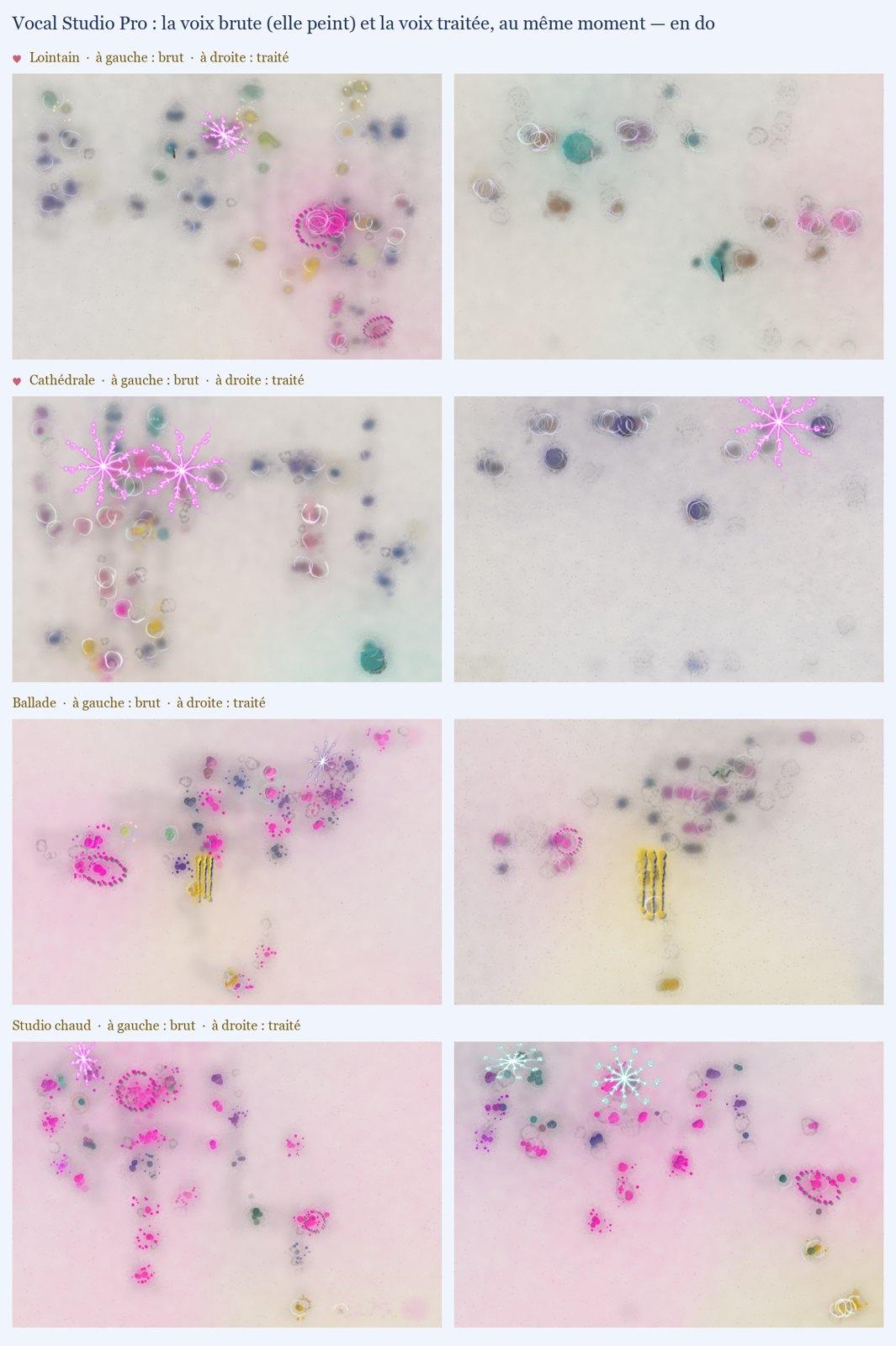
I painted the same take twice: once using my raw voice, and once using my voice as processed in the studio (reverb, compression, equaliser). The two canvases are different: that is why the raw voice paints, and the studio voice is the one we listen to.
What I did
I ran my recordings through a range of studio effects, one by one and then all together: room reverb, cathedral reverb, ‘distance’, compression and an equaliser. I then let the tool ‘paint’ each version, and compared it to the ‘painting’ of the raw voice.
What I observed
The pitch and the whistle of the ‘squillo’ remain unchanged. However, the reverb fills the silences and becomes breath: in the spaces I prefer, the tool detects 44–56 per cent breath, and the recognised vowel drops to 54–65 per cent. Even a ‘natural’ setting, which cuts only the low frequencies, alters the vowel heard nearly one in five times. The spaces empty the canvas; compression keeps it alive.
What I make of it
The tool has learnt my raw voice: in a space, it also hears the room, whose reverberation is superimposed on the voice. The voice that paints is therefore the raw voice, that of the air picked up by the microphone; the studio voice is its essence, the framework offered to the listener, like a canvas or a plinth. The studio frames: it never alters what has been painted. It does not correct the voice itself; it acts on its level, on its position of emission within the space and on its distance (the ‘distant’ setting).
Yet I sing better when I can hear myself in a space: my voice reaches me through the air and through my body, whereas the microphone picks up only the air. Through the headphones, space places my voice outside of me: I hear it as a listener would, and I enter into singing. Space is what I hear whilst I am singing; the raw voice is what paints.
Questions
Could a work depict the voice and its space together, the voice in layers and the room as a veil?
References
Georg von Békésy, *Experiments in Hearing*, 1960 (on the bone conduction of the voice).