
My three voices, slow and hurried: speed changes the texture
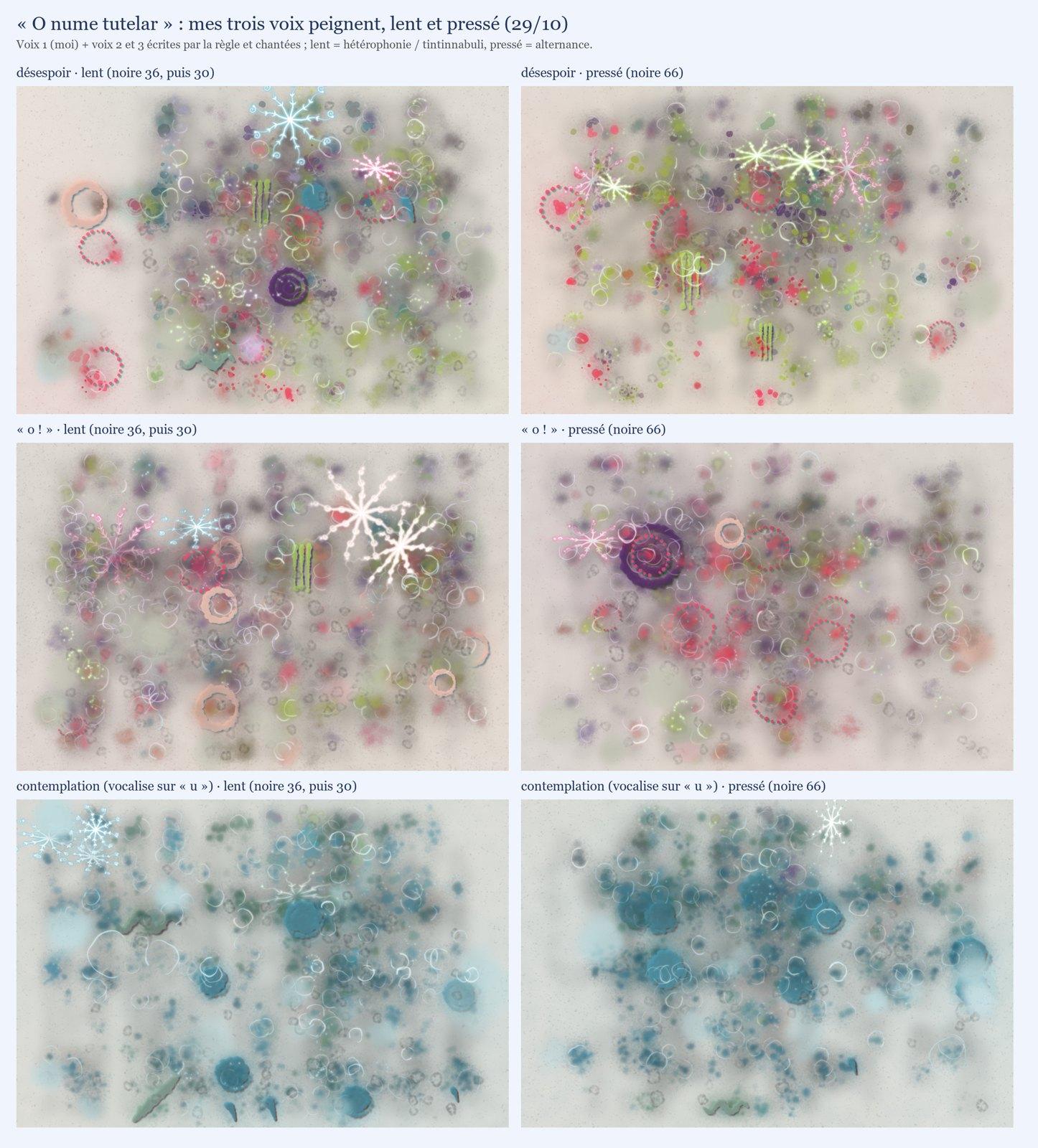
The same versions of ‘O nume tutelar’, this time for three voices, each sung and painted separately: at a slow tempo, the voices respond to one another; at a brisk tempo, they alternate, and the canvas reflects this.
What I did
Around my Voice 1, the rule wrote two further voices in the form of textures: a slow heterophony for despair and the ‘o!’ version, a slow tintinnabuli for the vocalise on ‘u’, and an alternation at a faster tempo for all three. I sang twelve takes, one voice at a time; the tool then painted each voice onto its own layer: three layers per canvas.
What I observed
The vowels hold true: the set of vowels copied from my Voice 1 is preserved in nine out of ten notes. Voice 2 is in tune (with a deviation of around twenty cents at the slow tempo); Voice 3, which is low-pitched and ornamented, is less so.
The result varies between the voices. At a slow tempo, the sung interval between two voices is within 20 cents of the written interval in only one in every four or five instances; the tintinnabuli achieves the best result, because the voices there follow the notes of the chord. At a fast tempo, the alternation does not hold: only one in ten instances. Voice 3 of the hurried despair descends to C♯3 in arpeggiated eighth notes: too difficult to sing at this tempo.
On the canvas, the vocalise on ‘u’ remains blue and airy; despair and ‘o!’ fill the canvas, almost to the point of saturating it.
What I make of it
The difficulty didn’t lie in the notes, but in the need to stay on my own melody without being drawn in by the voice I could hear through the headphones. The guide melody is enough to sing a part: if the parts share the same tempo, the same time signature and the same compositional criteria, each paints its own layer. Bringing them together into a single track for listening is a studio task, not something my voice has to do during the take. Finally, the texture is chosen according to the intention, and the tempo along with it: both must be considered together.
Questions
Which texture for which tone, and at what speed?
Three full layers: how full can the canvas become without losing its individual voices?
References
Gaspare Spontini, La Vestale (1807), ‘O nume tutelar’ (score, Pinna edition, IMSLP, public domain). Tintinnabuli: Arvo Pärt’s technique, with one voice on the notes of the chord and the other on the melody.