
My vibrato, natural or plastic: ripples on the water
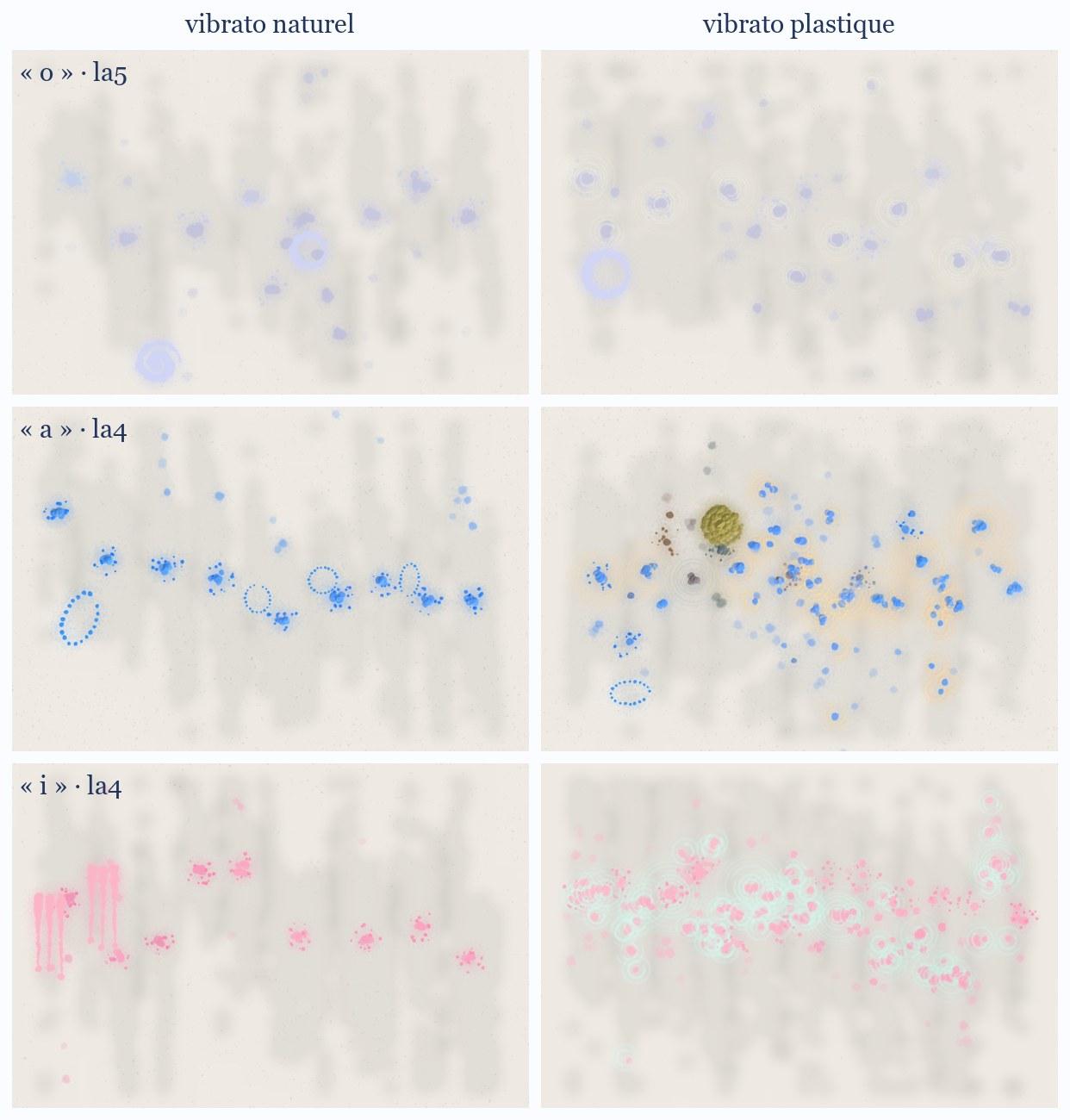
The same note, the same vowel, with the vibrato that comes naturally, then the broad, deliberate vibrato. In painting, the vibrato becomes ripples in the water: their rings are the oscillations, their spacing the width, their regularity the consistency.
What I did
I sang each vowel on a single note per take, for one minute, first on A4 then on A5: first with the natural vibrato, then with a broad vibrato that I control, which I call ‘plastic’. The tool measured the pitch oscillation (its width, its speed, the part of the voice where it appears), then ‘painted’ each take.
What I observed
My natural vibrato is almost non-existent: 22 to 28 cents, barely more than a straight voice, and slightly low (−55 cents). The ‘plastic’ vibrato is present across 50 to 70 per cent of the voice, with an amplitude of 95 to 100 cents, at 4.3–4.7 oscillations per second. The painting shows this: large circles around the ‘plastic’ vibrato markers, and almost none for the natural vibrato.
What I make of it
Natural vibrato is driven by the breath, by the contraction and relaxation of the diaphragm: it occurs when one knows where one is going, whilst singing a melody, and not on a note held mechanically. In my compositions, it appears; on these takes, it could not appear. Plastic vibrato, on the other hand, is controlled between two oscillations: its rings are regular. For these takes, I did not sing for the sake of singing: I sing to paint and sculpt, one sustained vowel per note, the voice that the rule must read.
Questions
What will the rings of my natural vibrato look like in a sung melody?
References
Carl E. Seashore, *Psychology of Music*, 1938. Johan Sundberg, *The Science of the Singing Voice*, 1987.